Monday, December 06, 2010

Mukhaputa - A movie review


As is usually the case, most watchable Kannada movies go unrecognized unless they get some non-local award. As sad and tragic as it is, it continues to be one of the banes of a once flourishing and creatively vibrant film industry that now reeks in the ruins ruled by mediocre-heavy jingoism. Fortunately, 'Mukhaputa' avoided that inevitable fate into oblivion as it bagged an award at the Ireland Film Festival and the Silver Sierra Best feature film award at the California Film festival.

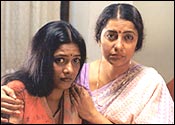
The story revolves around 7 year old Bhavati (quite an unusual and striking name) who is adopted by a social activist/PhD student/Bharatanatyam dancer Gauri (Roopa Iyer in her first debut venture as film maker) after the kid's parents commit suicide. Gauri is an orphan too, so the relevance of her understanding the kid's emotional distress at a deeper level than most comes as no surprise. The two bond quite naturally and soon she signs papers to become her official caretaker. Also in the loop are Gauri's foster father (Shashidhar Kote) and also her teacher/guide/philosopher. She turns to him for all sorts of guidance on both her career and life. With his untimely death Gauri's world is shattered more than that of his wife and unemployed son Shankar (a neat cinematic liberty naming his character that to ensure we are told that the he and Gauri would end up together at some point). The bereaved family takes care of little Bhavati as one of their own and time moves on.

One day Bhavati falls ill. On further investigation it is revealed that the child is HIV-positive which could possibly explain her parents' sudden deaths. Gauri is caught in a pool of dilemma on this discovery. On the one hand she definitely wants to ensure that Bhavati has as normal a childhood as she can get, but she also isn't sure how to go about it. On a chance encounter with an aged guru at a spiritual center, she gets some sane advise. An advise that is possibly the only deciding factor in how things are made and broken in today's world. That, of knowledge. She seeks out to know everything there is to know about the disease so that she may plan the best route to the future possible for Bhavati. Shankar, in the meawhile, is shown to be an out of work IT guy who isn't really keen on doing anything special in life. Since he harbors romantic feeling towards Gauri (no points for seeing that coming) he decides to join forces with her in bringing warmth, love, affection and most importantly a sense of normalcy in little Bhavati's young life.

What struck me most about the movie was its optimistic take on something as dire as AIDS and its associated taboos in India. It is obvious that Roopa Iyer is personally vested in both the awareness and education of the disease given her commitment in making this feature come alive. Though her prowess as an actress could have been sharper, it doesn't really interfere much with the bigger picture/message the movie tries to send across. The supporting cast lend apt support including the little girl playing Bhavati. A few scenes are placed just to get a popular face into the mix but I guess it is only such marketing strategies that helped her get the movie across to these festivals. A slightly stronger screenplay was needed specially in the scenes where Gauri confronts Bhavati's teachers for isolating the child due to her illness. A grand opportunity to highlight the irony of an educator practicing blatant discrimination purely based on ignorance is woefully lost by Iyer. She chooses, instead, to smear the scene with a background score whilst making the goings on inaudible. The gist is clear of course, but a concrete vocalized version would have made the audience root more firmly for Gauri. It is in these inadequacies that Iyer's lack of experience in film making becomes apparent and makes her character more impersonal.

All said and done, 'Mukhaputa' is eventually about the bigger picture which is killing the social stigma associated with AIDS and the millions of innocent kids who are targeted each day around the world for absolutely no fault of their own. If even a few hearts are forced to reflect on their beliefs after watching this movie, then I'd think Iyer's efforts have found success.


Saturday, October 23, 2010

Sugreeva (2010)

Ever since its marketing campaign began, the team behind 'Sugreeva' had blown several trumpets to herald the making of a movie as being a historic one in the entire time line of Kannada cinema. With 10 directors,10 cinematographers and a super tight schedule of 18 hours, if not anything else it certainly created the apt amount of curiosity. Such an ensemble, needless to say, requires immense coordination and dedicated team work which I must admit is a rarity in all of Indian cinema, let alone the Kannada film industry. For this, I certainly tip my hat to the crew of 'Sugreeva' with special mention to the producer Anaji Nagaraj.

Now to the meaty parts of this multi-layered dish. It is the story of a middle class income father Sugreeva (Shivraj Kumar) who takes a bunch of people in the emergency ward of a hospital hostage since he doesn't have the money to finance his only son's heart transplant operation. While the concept by itself may seem new to some, one has to realize that this just happens to be, sadly, a remake of another mediocre movie called 'John Q' starring Denzel Washington which was released in 2002. Whats worse is that movie was then remade into Hindi starring Sanjay Dutt in 2006 as 'Thataastu' which sank into oblivion without so much as a whimper. Why this Kannada team would hence choose to remake a mediocre original and a flop Hindi counterpart is beyond me. But nevertheless, they did and the outcome unfortunately isn't anything spectacularly different either.

What does help the cause is Shivraj Kumar. Given his age and the fact that the schedule was a jam packed 18 hours, it wouldn't have been easy to make the swift transition from set to set, place to place and the roller coaster of emotional quotients. It is his energetic presence which actually makes this otherwise mediocre fare seem somewhat bearable. Had it not been for his consistent conviction, this movie would have been an absolute disaster to view. For that, one needs to congratulate the veteran for still being in high spirits when it comes to physical and mental contribution to such a project. Right from being the doting father to the ambitious dancer to the desperate hijacker, Shivraj Kumar brings a lot of commitment to the stage which just about manages to keep this movie engaging enough to watch till the end credits roll. Yagna Shetty sort of repeats her role from 'Eddelu Manjunatha' as the helpless middle class wife stuck in desperate situations. I look forward to seeing more of her given her immense potential to be onscreen level of comfort but I also hope she doesn't get typecast in the same role each time! The supporting cast chips in as appropriate with the slight exception of the ill tempered cop who, for some unknown reason, takes the whole event rather personally and wants to shoot the hijacker dead without proper introspection of the causes and consequences of the event. Cinematic liberty, perhaps.

Given its limited time frame, 'Sugreeva' doesn't feel entirely like a haphazard attempt. It certainly is inconsistent at times with some portions being action heavy and other being extremely melodramatic but still feels like a regular movie. How the presence of 10 directors and the 10 cinematographers really aided in enhancing the quality of the story is something that alluded me. What's sad is had this been an original thriller, it would have probably gone on to be an iconic milestone in all of Indian cinema in fact. But it seems the focus was more on making that 18 hour shooting record rather than spending a few more hours thinking of an original script. This semantic ends up harming the film profusely with some needlessly forced comedy scenes and an extended version of a reality dance show with a mandatory dance by Shivraj Kumar which doesn't gel well with the narrative.

Many years ago 'Idu Sadhya' had suffered the same problem. The plot was so cliché and predictable despite being a murder mystery that the entire marketing gimmick of it being shot in 24 or 48 hours (I think!) was absolutely meaningless. Producers tend to forget that the time taken to shoot a movie has nothing to do with its eventual quality. If that had been the case then the 'Lord of the Rings' trilogy should have been a gigantic disaster at the box office. Nevertheless, 'Sugreeva' is certainly a one-time watch.


Saturday, October 16, 2010

Manasaare (2009)

Dear reader,

This seems to be a month to get after the esteemed Kannada film maker Mr. Yograj Bhat. I had already posted a blog taking a shot at the man for dishing out a plate like 'Pancharangi' but this time, after watching what I was told was a very popular 2009 movie - 'Manasaare' - last night, I just had to use a different way to explain myself. Its an experiment, I know, but I still hope it is entertaining. :)

Please feel free to click on the strip below (might take a little time to load!) to view the entire enlarged version of the comic strip. It is in English for purposes of a wider audience. If for some reason it does not load according to your liking then you can always go to the direct link here.

Also, if you've seen the movie and have a different take on it than I do, you know there is a comments box right below. ;)

Enjoy!


Krishna'n Love Story (2010) - a review

Ever since the golden age where movies like 'Nagarahavu' were made in the Kannada film industry, the theme of young love has been explored to a great extent. Now almost every week we have a movie that invariably claims to have found a new way to depict that same funny emotion – love. In that aspect, the publicity material I saw of 'Krishnana Love Story'(KLS) in Bangalore earlier this year weren't any different. What did catch my attention though was the director Shashank's statement that the movie was based on a real story. Now being a huge aficionado of stories that reflect some degree of reality, I actually was quite eager to watch KLS after hearing over the grapevine that Shashank's previous venture 'Moggina Manasu' was also a successful venture. From the posters of the flick I had seen around the city, I was expecting it to be a clever, amusing, sarcastic even witty take on modern love among young adults and how friendship plays a critical role in enhancing the same. In short, a very mature love story seemed at hand.

The movie started off on a promising note. We have a college dropout Krishna (Ajay) who is involved in the clothing business along with four of his close friends. He also, on occasion, helps out in his father's kiosk selling biscuits and cigarettes. He comes from a middle class family that depends largely on numbers and statistics to make their month find some coherence. He rides his father's gift to him, an aging motorbike christened 'Hombegowdru' after his late grandfather. A bike that is shown in the publicity material as being an integral part to the plot. So far, the backdrop is refreshingly interesting and pretty relatable.

Then we move on to Geeta (Radhika). Yet another middle class girl who is finishing her graduation and is quite conscientious about her studies and is shown to have neither the time nor the patience to find a boyfriend and roam the city streets aimlessly. Her older brother, uncharacteristically somehow, is a local rowdy who makes his moolah by slashing off people's cheeks. There is also the mandatory inclusion of their husband-less mother(Umashree) who works as a tailor and of course has a weak lung. Slightly cliché for my taste but well, I waited on hoping the main plot wouldn't be so.

Then the obvious happens. Krishna sees Geeta and falls in love immediately. But Geeta makes it clear to him that she isn't the kind who has the mental faculty for such silliness and that she has other priorities that need taking care of. She also conveys that it's not even his middle-class status that is stopping her from reciprocating his initiatives by clearly declining similar motives by a more wealthier and much well established rival of Krishna. This characterization of hers made sense and certainly set up the platform on which the movie could've been potentially narrated in a meaningful and consistent fashion.

But near the intermission portion is where things start going on a familiar, almost bizarre, curve. Suddenly one day, after having confessed her love to Krishna since he helped out during a family crisis once, Geeta decides to elope with the rich fella. Reason? Mysterious. On her way to their secret wedding in Dharmasthala, Geeta and her beau are involved in what appears to be a pretty intense car accident and miraculously, but not surprisingly, Geeta escapes with minor injuries while the rich fellow dies. Geeta returns home but refuses to show any emotion to anyone around her, including Krishna who in the meanwhile is shown to have forgotten all about her and started moving on with his life. Now that she is back, with great effort Krishna re-enters her life trying every trick in the book to get her to share her hidden feelings with him. In fact, both the families also agree that Krishna should take her away from the hubbub of the city to try and get her to open up about two things – a) why she took off with that rich guy so randomly and b) why her personality has changed so much since she returned.

This is where I was most hopeful about the story. At this juncture, I thought, was where the plot would give us that much needed surprising twist that would justify the entire premise of Geeta's insane behavior after returning from her escapade.

Reader, sadly, that moment never comes. The only justification, if we can call it that, we get is that she had realized that Krishna's love came with budget limits. That her life had been spent so much already in woeful financial misery that she wanted to get rid of her middle-class status and finally live life the way she truly wanted to. This is where the whole story turns on its head and becomes an absolute farce. One of the biggest loopholes in the plot is right here given that she had been so averse to the concept of wealth and living big that she had declined every motive from the rich chap initially. If we argue that it was indeed the desperate need for funds that drove her over the cliff eventually then why couldn't she share this with Krishna whom she trusted so much? Did she not genuinely see a future with him?After all, when things got bad with her mother, was he not the one who was taking care of both of them? So why on earth would a rational seeming girl like her reject his love and choose to go with someone with a lot of money? Whats worse is that she then goes on to blame him for accepting her back! She goes on to accuse his unconditional love for her as being the reason she cannot put her guilt behind her! I am sorry, in the real world, where meaningful things tend to take place, a girl in her situation would have thanked the guy who is so large hearted and genuinely good, that he is willing to give her a second chance. Heck, even if we assume she eloped under stressful conditions, all she had to do was tell him this was the reason she did what she did instead of sticking her head into a pot full of self pity and extreme insecurity about her own decisions. Very, very bizarre turn of events, I thought. A serious, obvious and painful hole in the plot. The story ends on a needlessly tragic note where you don't really feel any compassion for either of the lead characters since their actions post intermission have been so contradictory to their initial shades.

Speaking of technical stuff, sure, the camera work is pretty good and the songs are well choreographed. A couple of hummable tunes are also included with 'Santeyalli Nintaroonu' being the pick of the lot. But as is the case mostly, the songs do not help the story move forward and act merely as place holders for people to get a breather from the intensifying plot. For that, I thank Shashank. Performances are stable but all limelight is on Radhika Pandit in the post intermission parts where she seems inspired by Kalpana's Kaveri in 'Sharapanjara'. Her mood swings are overacted in some places and she ends up falling seriously short of justifying what could have been a milestone role in her still budding career. Ajay is alright but he doesn't seem to have a wide range of emotions to display like Radhika does. The only time he does display some variation in his performance is during the final scene, but its too late for anyone to care.

The bottom line though, remains this. In a time when Kannada movies are so desperately seeking some decent plots, some challenging characters for the female leads, some coherence in the narrative, KLS comes across as a contrived effort in its eventual execution. It becomes blatantly obvious that the director could not think of a creative way to justify Geeta's whimsical decisions and so decided to smear her wonderfully crafted character with juvenile reasons of self-doubt and self-apathy. KLS eventually turns out to be a colossal waste of good talent, great opportunities and most importantly, our precious time.


Monday, September 22, 2008

Aramane (2008)

I READ ON SOME WEBSITE that Kannada’s ‘Golden Star’ Ganesh had declared that his movie ‘Aramane’ was a super hit! Now as much as the hero of any movie would want to say the same thing, I somehow had a nagging feel that our 3xnamaskara TV lad had gone a tad astray with that expression. Ideally it is something the cine-going audience should mouth so he’d probably choose something more apt like ‘why don’t you ask the audience’ or something to that effect. Regardless, to make things clear for myself I decided to watch this movie the other day.

First things first – it is not an unwatchable movie. But then, it isn’t great either. There are several reasons for this and the main culprit here, as always, is a script that begins pretty unrealistically and catches more bizarre heat in a matter of a few frames.

So we have a liquor happy millionaire (Anant Nag in another decent and stable performance) sitting all alone in his million dollar palace sulking at the loss of his family. Oh no, no one is dead! Well, except his wife maybe. No – they just deserted him since he wanted to get married again after his wife had just passed on. What nerve, you ask? Oh you can’t blame the poor old fellow since he is just keeping a promise made to his dying wife who, for some reason is convinced of two things – one, that she will definitely die and two, that the man will definitely be alone some day. Let us pardon the woman though. She is dying so chances are she is a tad delirious. Fine – but does the old man break this little secret to his younger ones when they confront him? Oh no. That would be just too simple now wouldn’t it? No – he actually chooses not to share the reason of his sudden craving for another partner because, and I quote ‘he doesn’t like the way his children reacted to his move’. I wonder, what kid would thump the father on the back and say ‘Way to go dad!’ just a few days after the mother has passed on. What’s worse is thanks to this little tiff they move on with their lives and garland their still-alive father’s photograph without a care in the world! As I mentioned – a pretty weak backdrop to start off with if one is going to be showcasing something this big.

Well let’s forgive that and move on. So now we have drunken Ol’ McDonald with his farm of a mansion with just one loyal servant. Enter Mr. Photographer (Ganesh) who is assigned the task of taking a photograph of the old man. Needless to say the drunk tells the young click-happy lad to get lost and Mr.Photo-walah (Psst…there is an absolutely ridiculous back story to how the young fellow got that camera in the first place but I will leave it out of this review since, well, it is better to watch it yourself.) decides to do just that. As you might have guessed the old man magically feels a natural ‘tug’ at the lad and welcomes him back with a clean shave and a Kodak smile. A little too soon? Sigh – lets forgive this as well and move on.

As the two men – one drunk and the other nearly wasted – sit shooting the booze after a ‘one click’ session, we realize the main plot of the movie. The old man wants his family back and he eagerly assigns the task to the young stranger. What do you know – a few more minutes and the eager-beaver photographer is playing Mr. Bond under cover for a man he met only for a few brief minutes under the influence of liquor. The story chugs along as we are introduced to all of the old man’s kids – giant talents like Tara and Avinash wasted in ridiculously small and meaningless roles – and Photo-Walah bhai sa’ab is busy clicking photos of these people and gifting it to the old man. All the while falling for the old man’s grand daughter, of course. (I wonder why Indian heroes are so fascinated with ‘falling in love’? We’ve all been there. Could he not fall in love for a change and just go ahead with what is assigned? Oh well… )

After a few ‘fantasy’ songs and beach side shots - the ‘big’ twist! The girl loves someone else! Nooooo….!

Mr. Photo plays the ‘good guy’ after a quick weep in the men’s room and sets himself up for another piece of sacrifice for the old man and his family’s sake. What happens next is anyone’s guess and you can go ahead and do the same – if you care, that is.

There is something fundamentally inaccurate about the execution of ‘Aramane’. Editing is clunky in some important sequences and camera work is pretty amateurishly done for vital scenes that require facial emotions to be on display. A few songs stick out – ‘Nanagu ninagu…’, ‘Kolle nannanne…’, ‘Nagu nagu…’ among others – but aren’t enough to save this debacle from plummeting to the ground. Face first.

Oh! I forgot to mention the leading lady. Or wait, was she? Considering she walks around proclaiming Mr. Photo to be her ‘best and only friend’ while having matrimonial thoughts about someone else doesn’t make her character believable either. I felt sad for the doctor guy (the one she really loves) since he’d probably shrug his shoulders and say ‘Wait…so I am not your best friend? Meaning you don’t think I am good enough to share your secrets with? So wait, why are we getting married then? You go around telling everyone you don’t have a close friend…then what the heck am I???!!!!’

Sigh. Loads of such glaring and unexplained voids make ‘Aramane’ fall short of its potential. I wonder if the script – as weak as it was – would have received better treatment under more experienced hands. It is a shame Ganesh – who has dozens of more genuine hits to give before he can call himself a ‘Golden Star’ – is becoming part of such mundane fares with increasing frequency. At this rate it won’t take long before the ‘G’ disappears and all that will remain is ‘Olden Star’.

But then, I am sure he knows best. Right?


..ShaKri..

Wednesday, October 25, 2006

Minchina Ota

‘Minchina Ota’ illustrates the life of a criminal. The age old saying that crime does not pay is portrayed in this feature. Katte (Shankar) and Thatha (Loknath) are petty thieves who can’t seem to get a break in life. Their criminal past does not leave them wherever they go. Being the lazy and hopeless souls that they are, they decide to hit it big. They start jumping unsuspecting passers by on National Highways and relieving them of their automobiles.

Soon their jig is up when one of their stolen vehicles breaks down and Tony (Anant) is brought for help. Seeing that money is a free flowing concept in this criminal life, Tony joins hands with this crime duo. Soon the trio is hitting various spots and making away with vehicles. During this process they even manage to rope in another helpless soul Manju (Priya Tendulkar) into their criminal enterprise.

The cops are hot on their trail for a good part of the movie before finally clamping the trio down much to the delight of the pipe-smoking Inspector (Ramesh Bhat). As jailbirds Katte and Thatha seem to have found their peace but not Tony. His desperate self is trying to get away from the chains that bind him. A prison break is planned and executed to almost perfection by the three. But as it has happened in the past, as you sow so shall you reap. The same holds good for these guys’ fates.

‘Minchina Ota’ is considered one of Shankar Nag’s best works. Being an ardent Shankar fan myself, somehow, I missed the spark in this feature. The story has a very predictable process to it with no major surprises as such. The needless inclusion of songs makes this a rather casual affair. I had expected a tight edge-of-the-seat thriller but was disappointed to see another pot boiler termed as a ‘based on a true story’.

Performances wise everyone does a good job. It was refreshing to see the energetic Shankar Nag and Anant Nag brother duo. It is indeed an unfortunate blow that our industry lost a great artiste in Shankar.

Music is fair and editing is good. Supporting cast lend apt support as applicable.

Shankar does a good job at narrating a story that keeps its consistency despite the predictability factor. But for me, as I said, the ‘minchu’ was not that bright.

2.5 out of 5

Saturday, August 12, 2006

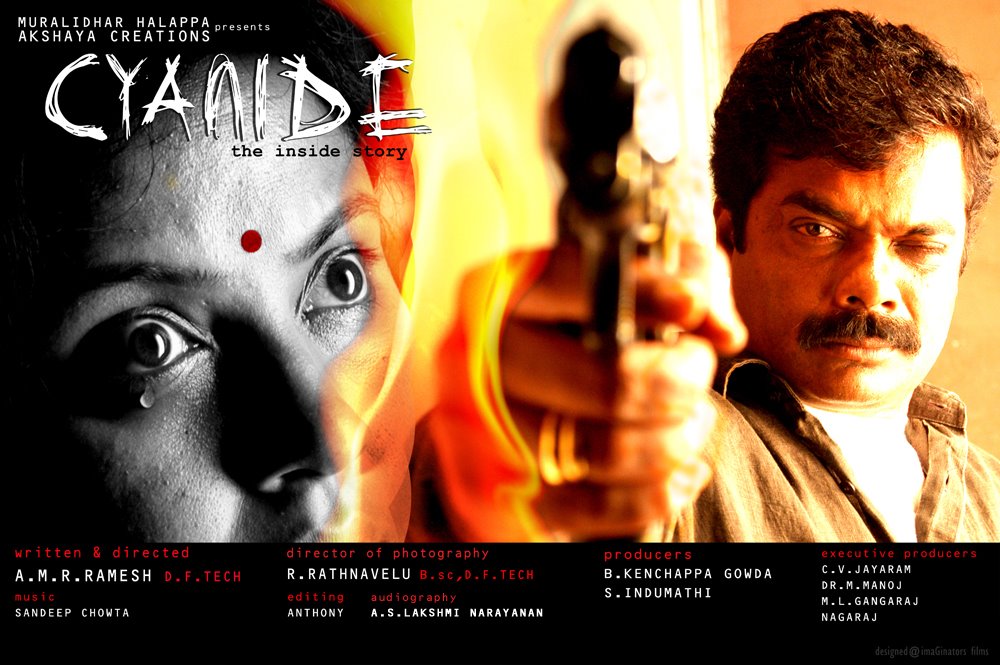
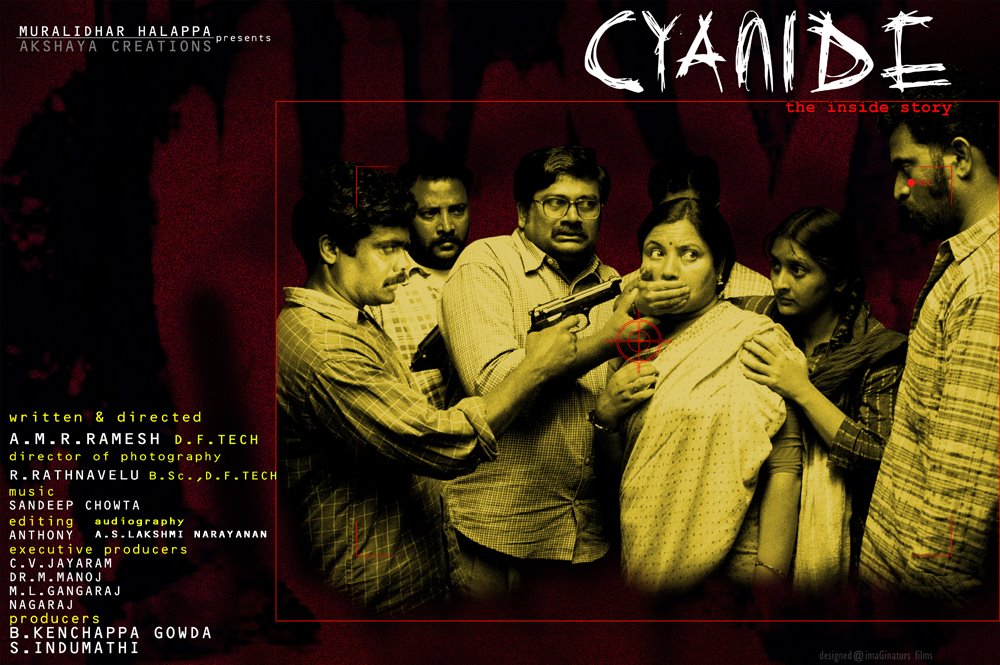
Cyanide (2006)

Cyanide (2006)
Featuring: Tara, Ravi Kale, Rangayana Raghu, Avinash, Malavika and others.
Directed by: A.M.R Ramesh


For the past few years Kannada cinema has had to suffer mediocrity. In fact I had written about it on this blog site as well. But this summer in India was refreshingly different. If ‘Rama Shama Bhama’ was the rib tickling delight for Xmas last year then ‘Cyanide’ was the pick of the year for me this summer.

For those who are not aware ‘Cyanide’ revolves around the shocking assassination of India’s former Prime Minister Rajiv Gandhi by hardcore LTTE militants. This was the first time that a human bomb was used to execute the task.

Contrary to popular belief (that is belief of people who have not seen the feature) the movie is not about the causes and effects of the assassination. It neither takes sides on the cold blooded murder that shocked the nation nor does it justify in any way what was done was right or wrong. All it does is showcase the days that followed the killing of Rajiv in Siriperambudur and the day the LTTE militants responsible for the attacks killed themselves in a house in Konanakunte outside Bangalore by consuming cyanide. The leader of the gang Shivarasan backed by Shuba and others were found dead one cold morning when commandos barged into the house. Inspector Kempaiah headed the entire operation along with aid from the CBI officials in Delhi to avoid these hardcore killers from fleeing. As the common news watchers we never knew what exactly happened after the bombing and the day the militants were found dead. ‘Cyanide’ showcases those days with brilliance.

The one thing that hits you immediately while watching ‘Cyanide’ is the brilliant cinematography. Ratnavelu is an upcoming genius of a cinematographer who has worked in Tamil and Telugu films before this has captured the on goings onscreen with such precision that it leaves the viewer dumbfounded. The next best thing which hits our senses is the sleek and polished editing. The manner in which the scenes are stitched together with the appropriate amount of screen time given to each is absolutely amazing. I have not seen many Kannada movies with such laudable editing work. The third and most important aspect which sticks out majestically in ‘Cyanide’ is the glorious background score. For those expecting some hip shaking gyrations here will have to resort to some of Vishnuvardhan’s latest since all one gets here is a treat of mind blowing scores by Sandeep Chowta.


The cherry on top of this beautifully adorned cake is the director – A.M.R. Ramesh. A grand debut by a fine movie maker. His genius is apparent in the way he handles the scenes involving the LTTE militants and the innocent housewife Mrudula and her husband Ranganath. The former Prime Minister is never mentioned by name yet is present in wide audience throughout the movie. Ramesh truly deserves an applause for enriching our cinematic experience with ‘Cyanide’. All the performers shine with special mention to Ranagayana Raghu who underplays the role of Ranganath with enviable precision and Shivarasan’s character Ravi Kale who breathes fire into his role. Tara and Malavika excel in their respective roles and have their moments too.

Some of the scenes that caught my attention and appreciation:

  • Militants barge into Ranganath’s house unannounced much to the shock of the innocent wife Mrudula.

  • Shuba finds her lost self in Chitradurga’s valiant woman warrior Obavva while watching a song on television. The tears in Shuba's eyes narrate a million stories.

  • The dated presentation of the events throughout the movie.

  • Glimpses of the regular and fun filled militants’ lives back in Sri Lanka just before they crack open the cyanide in their mouths.

  • Mrudula requests the police officials to kindly ensure her gas cylinder and stove is returned as they prepare for the final showdown with the militants.

  • ‘Yes. It was a mistake. Killing your Prime Minister in your country was a mistake.’ is Shivarasan’s frank response to Ranganath when asked if killing the former PM was a mistake.


All said and done I can only pray and hope that Ramesh continues to enthrall us quality deprived Kannada movie-goers with such rare treats in the future as well so that we too can get over our ‘Remake Fever’ once and for all.

Thank you – everyone connected with the making of ‘Cyanide’ - for making my summer so special.

I request readers to kindly check out 'Cyanide' movie's official website at CyanideTheFilm.com

Sunday, May 21, 2006

Olu Saar Bari Olu

Olu Saar Bari Olu (????)
Featuring: Ramesh, Anu Prabhakar, Balraj, Jayanti, Mohan and others.
Directed by: Nagendra Magadi

Tipped off with Upendra’s hit number “Olu bari olu” a host of movies brought the word “Olu” into limelight. Considering the literal meaning of the word “Olu”, all the movies with this word in them are invariably a run of the mill comic features. One of the reasons I sort of hesitated to watch this movie was due to the overused and overdosed and definitely overacted patterns this word has come to inherit over the years. Even the presence of “The Ramesh Factor” could not bring me to see it since I was in no mood to watch Ramesh make a fool of him self in a sorry little affair like this one. The expression “Don’t judge a book by the cover” definitely fits like a T for this movie since I was pleasantly (and sometimes shockingly) surprised at what it had to offer.

For starters “Olu Saar Bari Olu” (OSBO) is an absolute riot from the get go. The story begins with Ramesh who works as a make-up person in a film studio and his irate and miserly landlord Bank Janardhan. Ramesh’s life has a host of issues including being able to stay on the good side of this cheap little man who wont allow even a housefly to get away with free merchandise. With a scene like this Ramesh’s younger brother Pramod arrives in the city to study medicine. Before you know it his other two friends Mohan and Balraj join him with circumstances beyond their control. Now what we have is the stage set for these four bachelors to manage a life in the city without hassles.

Of course, being single men is never easy and that includes accommodation. When Ramesh and Co. manage to manhandle the landlord and his wife in a drunken state one night it is time to move on and find greener pastures. In their pursuit they manage to hook onto an unsuspecting lady Jayanti Deshpande (Jayanti) who is told that the brothers are married and will be bringing their ‘wives’ to the city soon.

Presto and we have a rather ‘well-built’ pair of women (Balraj and Mohan in disguise) entering the house posing as the wives. A typical ‘Golmaal’ affair with a string of events making this one rib-tickling ‘Comedy of Errors’ as it were. Despite the lack of any major turn of events what keep the viewers glued are the comic sequences that are amazingly well controlled and choreographed. The two men – Balraj and Mohan- deserve a grand round of applause for playing a woman with finesse. I can honestly say they fitted the role like a glove.

Performances wise everyone chips in equal share. In their limited screen time the leading ladies for these four guys do what they can although Anu Prabhakar gets more time than the others due to the ‘star value’. Ramesh is as always his best with the right timing for the right sequence. Seasoned Jayanti does her good-mother shtick with precision. Music is pleasing to the ears although the songs have nothing to do with the narration of the story which is a popular culture anyway.

Leave your brains outside for a change and have some wholesome family fun. Not many Kannada movies out there with this sort of comic quality.

Sriram

Sriram (????)
Featuring: Shivraj Kumar, Ankita, Abirami, Sreenivasa Murthy, Jai Jagadish, Avinash and others.
Directed by: M.S.Ramesh

Shivu (Shivraj) is a handyman working for a power-player/bigwig somewhere in Hubli. He has been there for a few years now and is shown to be a part of the family despite the fact that he is a stranger to them. Kshetrapal (Avinash) is a Lokayukta officer who is going around mouthing powerful lines into the trembling faces of law-breakers. Unfortunately for Avinash this is as far as his role’s range really goes. His daughter Aishwarya (Ankita) is another ditsy PYT who falls for Shivu before even meeting the man. The haste in which they ‘fall in love’ is a clear indication as to how ‘vital’ that aspect of the story was to the overall plot.

A couple of snow-capped songs, a lethal gun fire that Avinash actually comes out of and a few single-handed fights later, Shivu decides to tie the knot with Aishwarya. On their wedding day arrives one more slim and pretty tall thing – Vasundhara (Abirami). She reveals to the awe-struck crowd that Shivu is not what he says he is and is in fact – Sriram. Everyone looks at Shivu demanding an explanation for this cover-up as Sriram/Shivu locks himself into the past.

Intermission. Pop corn. Soft drink.

Post intermission revels in Shivu’s past. The script slavishly follows Valmiki’s epic Ramayana in this phase which ends up making the narration rather lackluster. A father (S.Murthy) with two wives who are shown to be uncharacteristically well-adjusted. A couple of step-brothers and this family’s power-grip on the city’s population. A Manthara-like character in the form of the second wife’s brother (whose daughter is Vasundara) et al. Her demanding Sriram leave the house to ensure more limelight to her own kids (who for some reason do not say anything at all!). There is also a local villain for the town in the form of Jai Jagadish who goes around spitting fire at Shivraj and his group of do-gooders. Everything that makes the goings on predictable and mediocre. The inevitable good wins over evil message with Sriram doing a Sri Krishna-act eventually by wedding both the girls who aspire to be his bride. How convenient, eh?

Performances-wise Shivraj delivers a very controlled performance in bits and pieces. His depiction of Sriram in the second half is loud, melodramatic and repetitive. Sometimes it is hard to identify with such larger-than-life and larger-than-law characters since they seem unrealistic. Despite this he manages to pull off a decent one as always ensuring justice is done to the role. The leading ladies are strictly ok although Abirami has more emotionally challenging scenes (for what its worth) than Ankita who gets nothing much to do except bat an eye-lid here and there and gyrate to a couple of songs. Supporting actors lend apt support mouthing super-heavy and surreal lines which make this affair a completely fictional and commercially designed one.

Music is pleasing to the ears with Udit Narayan belting a few choice ones in ‘his Kannada’. Technically the movie is very well shot which also includes a well choreographed chase sequence involving a moving train. I thought despite all the over-the-top (literally!) stunts in that one it was definitely a treat to watch.

Overall Sriram manages to keep the viewer’s focus till the end despite it’s almost- predictable climax. I wish the director had experimented more with such a time-tested formula with some innovative scenes with Shivraj. But he chooses to stick to the usual commercial demand.

Sunday, May 14, 2006

Accident (1985)

Accident (1985)
Featuring: Shankar Nag, Anant Nag, Ashok Mandanna, TS Nagabharana, Arundati Nag, Srinivas Prabhu and Ramesh Bhat.
Directed by: Shankar Nag

Lost in the world of drugs, sex and alcohol Deepak (Ashok Mandanna) lives with his head stuck in the clouds. What only adds to his jingoistic reverence to such a lifestyle is being the son of a powerful political player Dharmadhikari (Anant Nag). Without a soul to care about Deepak and his friend roam the empty streets of Bangalore under the influence of ganja and race strangers on the road.

This so-called classy pair one night manages to do the unthinkable. Their imported car manages to get off the road and into the stomachs and necks of innocent villagers who sleep on the footpaths of the city at night. People with no shelter, no prospect and no one to ask for. People who have traveled hundreds of miles in search for a better life. But unfortunately find a ghastly death instead.

In what is quite possibly one of the best shot action sequences in Kannada cinema, Deepak manages to drive on dozens of these poor and helpless folk that night. As his car bumps off a panicky and screaming Ramanna (TS Nagabharana) off to one side and bangs into a pole, Deepak realizes the trail of horror he has just become responsible for. In the pursuit of “getting high” he has managed to kill.

Ravi (Shankar Nag) and Inspector Rao (Ramesh Bhat) get onto the hot chase of finding out the whereabouts of this ‘mystery vehicle’ which spelt doom for the desperate. As Ramanna heals in the hospital with the accident still fresh in his mind, Ravi is leaving no stone unturned to seek the truth and bring justice. Dharmadhikari returns to the city to realize this shocking incident and is immediately on task to start moving the pawns of his political game to try and fish out his son from this mess. Caught between his ethics and the stink pool we call ‘the government’ innocence stands to be punished while crime is poised to make a quick exit.

Will justice go unnoticed? Will Karma find a way? ‘Accident’ raises more questions than provide answers. We need such movies that are mirrors to the corrupt and dog-eat-dog power tussle that our country has become notoriously famous for. Shankar Nag brings to life talking puppets that showcase images of real life events on the celluloid. All the characters in the movie deliver a hundred percent with no exception. A brisk narrative and expertly dealt editing work makes the feature all the more engrossing.

An excellent movie with a very strong social statement. Features like ‘Accident’ are proof of the quality and class Kannada cinema is capable of.


Ba Baro Rasika (2004)

Ba Baro Rasika (2004)
Featuring: Ramya Krishna, Sunil, Ashita, Ramesh Bhat and others.
Directed by: Dayal

‘Ba Baro Rasika’ is a movie with varying mood patterns. One of the main reasons I watched it was for Ramya Krishna who was impressive in ‘Rakta Kaneeru’ and Sunil who has time and again promised he has potential. That said, let us look further now.

Vishwa (Sunil) is a graduating student who is known to be the ‘life of the campus’ and a good friend to his peers. He is a guy who has, despite being some sort of ‘girl magnet’, always kept them at a safe distance because he has not yet fallen in love. Ironically it seems that he throws away his heart to the first girl – Sona (Ashita)- who walks into his arms (as an accident mind you!) and declares ‘I love you!’ making his whole ‘integrity shtick’ seem like a farce. Just when you are feeling good about the male lead being a man who is a little realistic he goes ahead and becomes cliché. Sigh. Once we get past this puppy love we are introduced to his and her family members. Ramesh Bhat is thrown into this mix as Sona’s enthusiastic and ‘love-affairs-are-ok-as-long-as-they-are-headed-for-marriage’ kind of father for a good measure and completely wasted. Regardless the two are convinced they are in love (if only it was so simple) and decide that they will “love maaDu with duet songs”.

Let us now look at the woman who gives even girls the inferiority complex. Ramya (Ramya Krishna) is the chief auditor for a firm and is shown to be an ‘anti-men’ individual. With a troubled past which involved a murder or two, she has grown up hating men (all kinds). She ends up interviewing Vishwa who impresses her with his statistical knowledge of the firm. Her aloofness and cold attitude is actually impressive during her initial scenes.

On a trip to Mumbai the two unearth a scam worth 22 crore rupees. Conveniently a goon threatens Ramya one rainy night and soon she is seen begging Vishwa to stay with her in the room for the night since she is ‘scared’. During one of her scary moments Vishwa and she end up in bed together. Sparks fly and before you know it Vishwa is weeping like a baby. This IS the crucial moment in the movie but is not shot with the sensitivity and maturity that it deserved. Vishwa is confused and guilt-ridden so he confesses in the church the next day about the folly. He puts it behind him and gets engaged to Sona.

All is fine and dandy until we realize Ramya ‘Men Are Evil’ Krishna is not quite over her ‘experience’ with Vishwa. The woman in her has suddenly risen and so she starts harassing our man with weird phone calls and bizarre scenarios. Her attempts at making him ‘realize’ her beauty could have used more creative ideas. Vishwa, who was smart enough to figure out statistical data and ward off goons, is shown to be so naïve that he plays right into her hands. How these situations get untangled and who does he eventually end up with forms the rest of the story.

This was a great script but is completely mismanaged by a director who does not seem to know how to handle such situations. At the end of it all it becomes another ‘run of the mill’ story like the rest of them. I was, for once, impressed with the opening shades of the lead characters but they become hollow and without definition towards the end.

Sunil holds the fort completely with his histrionics in this feature. He definitely has the components of a good actor in him and I seriously hope the man continues to get challenging roles. Ramya is adequate in her role although her post intermission ‘obsessive lover’ was nowhere near realistic. She was not persuasive. She was not even demanding which would have made sense considering her overnight ‘change of gear’. The girl cast opposite Sunil is ok although her character could have used some confrontational scenes with Ramya. Being a woman, that perspective is left unexplored. Others are just ok with their pre-defined roles and limited screen time.

Technically the movie is well shot. Song sequences are refreshing and as always are dream sequences with nothing to do with the story. Cinematography is good and crisp editing only adds to the gloss factor.

‘Ba Baro Rasika’ starts off with a lot of promise but loses its way due to the lack of a strong screenplay and direction. The director had a gritty lead cast but does not use them to their maximum potential. I look forward to more such themes being explored with a touch of reality to them.

Saturday, May 13, 2006

Sangliyana

Sangliyana
Featuring: Shankar Nag, Bhavya, Vajramuni, Devraj, Sudhir and Ambarish.
Directed by: P Nanjundappa

SP Sangliyana is a character inspired from the real life super cop with the same name. A man with high principles and honor for the law enforcement department of the country. The movie is a fictional depiction of the man, his encounters with law and the people who break them.

Sangliyana (Shankar Nag) initially poses as Rowdy Raju and enters the city. No one suspects a thing about this seemingly small time crook including the police department there and the big time power lords Nagappa (Vajramuni) and his errant son Devraj. While they make merry with the strings on their fingers which includes everything from corruption to prostitution, players of the same fiber join this bandwagon in all sizes and shapes. The only people who seem to be concerned at all about this mess of an infrastructure is newspaper editor Mahesh (Lohitashwa) and his daughter Kanchana (Bhavya). Minister Nagappa and his son indulge in all kinds of criminal activities making a mockery of the law which includes even bludgeoning a forest officer to death in broad daylight. With the middle men in the Police department, the father-son duo make merry with the very familiar air of arrogance and foolhardiness associated with such fictional features. The forest officer’s wife and son (Tara and Manjunath respectively) end up living with Rowdy Raju through an array of convenient coincidences.

One fine day the much acclaimed Sangliyana makes his appearance in the form of ‘Rebel Star’ Ambarish. He starts his first day with a nice ‘dishum-dishum’ of overpricing auto rickshaw drivers and is soon seen getting this mess in order. Constant confrontations between the ‘bad guys’ and the ‘good guys’ keep taking place with a few blood streaks and hollow threats.

Near to the intermission part the cover is blown and we finally see the real SP Sangliyana as Shankar Nag who would have, true to his unorthodox ways of handling crime, made a rather premature visit to the city’s crime scene. As we are relieved that Shankar Nag is finally out of the rather amusing looking hairdo and sunglasess as Rowdy Raju, we also have to contend with a couple of random songs which have nothing to do with the story’s progress. Of course, this is where you can stretch your legs and maybe take a coffee break.

One thing leads to another and Sangliyana successfully starts fixing all the loopholes created by Nagappa and Co. A traditional commercial potboiler style showdown ensues bringing criminals to justice and upholding the goodness of the law.

Sangliyana was one of Shankar Nag’s laudable features as the upright police officer. The movie brought back fond memories of lazy Saturday afternoons spent on the couch with the family watching these entertainers back in Bangalore. Shankar does complete justice to his role and is flawless as a performer. No amount of regret will ever be able to fill the void this brilliant man left in our land. Bhavya does her stereotypical actress bit efficiently too although she is loud and tends to get on the nerves at times. The performers from the ‘Bad Guys Camp’ – the late Vajramuni, the late Sudhir and Devraj are tailor made for their roles. It was a pleasant experience watching the legend Vajramuni perform with the ease of an experienced artiste. ‘Rebel Star’ Ambarish puts on a valiant performance as well in his guest appearance. One can tell that the emotion is heartfelt when he embraces Shankar which is a representation of the off screen friendships these people shared.

Music is definitely one of the high points of the movie. Made as a slick and crisp cop adventure the movie boasts of some good songs including the popular ‘Bandalo Bandalo Kanchana…”. Editing is well done and keeps the narration interesting and entertaining.

Overall, Sangliyana is a complete family entertainer with all the elements in the right doses. If you look past a couple of needless songs Sangliyana is a pleasant piece from memory we all can proudly acknowledge.


Saturday, May 06, 2006

Stumble (2003)

Stumble(2003)
Featuring: Anant Nag, Suhasini, MD Pallavi, Mukhyamantrui Chandru, Ashok Mandanna and others.
Directed by: Prakash Belawadi.

Finally a movie that talks about the technology our land seems to be so proud of. The land of Karnataka and especially Bangalore have been put on the international map thanks to this newfound miracle drug our economy has been administered with. I had always found it ironic that despite being home to so many global corporations et al, our film makers had never ventured into one socially relevant feature that showed us the in and outs of the industry. That irony is laid to rest for a little while at least with Prakash Belavadi’s feature - Stumble.

Anand Rao(Anant) – a retired bank official and Nandini (Suhasini) are leading a simple yet self-sufficient upper middle class life in the suburbs of Bangalore. Their son Uday lives and works in the United States while daughter Madhu (MD Pallavi) is a software engineer working for a supposedly well-to-do firm. This firm is run by a hen-pecked yet scheming white collar Dinesh Khosla. Things start going haywire when Madhu is fired randomly without proper reasoning. While Madhu seems to surrender to the event without a fight, she also has to put up with the blameful eyes her father has for her. Caught between a swindling finance corporation where he is destined to lose all his savings and his daughter’s failing prospects with a career, Anand Rao has nowhere to turn. He pines his hopes on his son Uday who returns one day with a pink slip in his pocket. Of course the family realizes this fact much later thanks to the one thing education has successfully taught all of us – destructive egoism.

Sitting close to this set of events is MLA Divakar (Chandru) and his political ambitions. In collaboration with Khosla and an American he manages to convince hard working and earnest bank employees to join hands into a new merger. Khosla’s technology oriented firm that once seemed to have great value in the global economy is now a sitting duck to collapse. The post-IT and dotcom booms are teased out of their hiding with Khosla deciding to convert his otherwise tech-based center into a call center. Armed with outsourced projects, Indians with fake accents and Americans with ideas of their own, Khosla and co. decide to hit it big. While a desperate Madhu is helped out by some of her loyal peers from work, others choose to join the bandwagon without caring where it is headed next.

These two scenarios collide giving us a rare glimpse of the dubious natures with which these organizations work. Everything from overnight Technology training centers to the cliché of the dog-eat-dog genre this field has created is well captured on celluloid. Prakash Belavadi does a good job at showing a very Indian perspective of the economic shadows that have been around for over a decade in Karnataka. A closer look at this seemingly rosy picture is taken through the eyes of the helpless middle class who only wanted a secure lifestyle and a good landscape for their future generations. The abuse young professionals have to go through at the hands of greedy and one-dimensional bosses are well portrayed.

Performances category is dominated by Anant, Suhasini and Chandru without a close second. These seasoned players perform brilliantly in this English-heavy feature. One of the beautiful touches the director gives is the appropriate injection of Kannada in certain important scenes which sparkles like a hidden water stream in a rocky and dense rainforest. Pallavi, Ashok and the rest of the cast chip in as appropriate in their tailor-made roles. The new faces onscreen adapt well to the goings on and deliver a pretty convincing performance.

Technically the movie is crisp and well shot. Editing is well done although camera work could have been more personal at times. A slight lack of this falls short of adding the genuine touch and life to some vital characters. Music is used sparingly considering the focus of the feature. Jobs are lost but a family is found hence increasing the realism in the movie.

Overall, ‘Stumble’ is another socially-relevant feature made at the right time. The call center business is shown as an infant in the movie but we all know the Herculean young man it is today. ‘Stumble’ is definitely worth a dekko.


Sunday, April 30, 2006

Anand (Shivraj Kumar's Debut)

Anand (Year of Release?)
Featuring: Shivraj Kumar, Sudharani, Bharati, Rajesh, Tara and others.
Directed by: Singeetam Sreenivasa Rao

Renowned Telugu director Mr.Rao brings to us the fresh face of Shivraj Kumar in ‘Anand’. The movie that is said to have begun the roots of his ‘Hat Trick Hero’ tag name. It is not hard to notice the shaky camera conscious performances of these first timers in the feature but regardless this debut vehicle of Shivraj is worth a dekko.

Anand (Shivraj) is a poor young college going lad who lives with his mother Kamala (Bharati) who is a nurse. He is revered by some in the college as a valiant and just individual. Nothing unusual so far considering this is how most ‘My-Daddy-Is-A-Big-Star’ off springs tend to debut. His nemesis is Shreekanth (I do not know his name) who is the son of a rich business tycoon Raja Chandrashekar (Rajesh) and is green with jealousy as he is unable to gather the affections of Mala (Sudharani). He plots various cliché confrontations with Anand to get ahead of him but sadly is left aching in both emotional and sometimes physical anguish.

While things are simmering with these scenarios we see a breakthrough when Raja Chandrashekhar arrives one day at Anand’s house fuming with rage. He warns Anand of dire consequences if he does not leave Shreekanth alone. As he is about to leave he meets Kamala and is sweating on his brow. Little wonder then, that we soon are enlightened that Anand dear is a not-so-dear illegitimate off spring of Mr. Big Shot’s days of ‘experimentation’ with Kamala. Anand vows to avenge this by claiming that he would make his father call him his own one day.

Sub plots emerge with Chandrashekar running for the local elections and is abducted by opponents (in a rather subtle way really) to ensure he does not register himself for the contest. This news spreads like wildfire and Anand is convicted for this crime. Does Anand put aside the indifference shown by the old man and save him? Will Chandrashekar accept this new-found son of his? Or is Anand truly a part of this kidnap drama? This is the part you will have to see the feature to find out.

Performances belong to Shivraj all the way. If you look past the lack of emotional options in his ‘Bank of Acting’ he actually pulls off a decent one. I look at his performances in features like ‘Om’ and use that as a case study for his career. But it was ‘Anand’ that started it all. We also notice how he was super agile physically and could manage the most realistic of stunts back then. He excels in a chase sequence where he hops from one terrace to another with a lot of ease. Sudharani is adequate as the other new-found-face of the lot. She acts with a charismatic innocence that provides her character with a lot of unintentional authenticity. Other seasoned veterans are used to ensure a decent run of this not-so-unusual plot with Bharati, Rajesh and the ever-cheerful-for-no-apparent-reason Chi. Udayshanker doing their bits with perfection. A young Tara also chips in a very confident performance in her stereotypical role. Others manage the cast of this feature pretty confidently.


Humor is used well in parts of the movie and gels in well with the storyline. Editing is crisp and keeps the goings on consistent. Music is pleasing to the ears although I have never been a fan of S.P.Bala’s English-Usage-In-Songs. A few popular numbers like “Tuvvi Tuvvi…” stand out of the lot.

Overall, ‘Anand’ is a well made movie with a consistent pattern in performances and the script. It was refreshing to see the not-so-polished first timers in Shivraj and Sudharani in their young romantics’ roles. If we applaud them for their roles today then we need to acknowledge their beginnings as well.


Saturday, March 25, 2006

O Mallige (1997)

O Mallige (1997)
Featuring: Ramesh, Charulata, Amar Mayur, Chaitali and others.
Directed by: V.Manohar


Kannada movie industry’s well known music director V.Manohar chooses an interesting story to launch himself as a director. “O Mallige” has shades of a lot of features that have dealt with similar themes in various languages – the well known and my personal favorite being Kamal Hasan and Sridevi’s dynamite feature ‘Sadma’ – but gives it a different treatment.

Mallige (Charulata) lives in a small village with her uncle played by V.Manohar himself. A heart patient, Manohar has an ambitious wannabe model in his son Nacchi (Amar Mayur) who is lost in the bliss of the big city. When he suffers another nearly fatal stroke, Nacchi reluctantly returns to be by his dying father’s side. Seizing the opportunity, the dying man manages to knot the innocent village belle Mallige to our dear city chap. As much as Nacchi hates the decision, he goes along considering his father’s health. He even manages to consummate the wedlock under the influence of alcohol. A few days later the old man dies leaving the helpless girl to his son. The very next day Nacchi takes off without a care in the world for the newly wed and naïve girl who has nowhere to turn for support.

Days roll by and soon Mallige realizes she is expecting. To take things under her own control she decides to join her absconding husband in the city. As one would predict our opportunist young man has shifted base and is shown wooing the rich daughter of a millionaire to fuel his aspirations of becoming a successful model. Soon the young couple is shown exchanging sweet nothings in parks and restaurants while the pregnant girl is roaming the streets of the city looking for her ignorant husband.

Towards intermission we are introduced to the real powerhouse of the feature in the form of Krishna Murthy alias Kitti (Ramesh) who is also an aspiring model in between odd jobs. An accident brings Kitti and Mallige together as she is seriously injured in the mishap and loses all memory of her immediate past. For his convenience to shoo off the prying landlords, Kitti brings Mallige to his house and christens her Lakshmi since she has no memory of her name. A special bond of affection starts forming between the two. Nacchi continues his Casanova ways with the rich girl unaware of any of these happenings.

Time continues to roll by and before we know it Lakshmi aptly bears Ganesha. Meanwhile Kitti manages to get a plum offer from the same firm that works with Mallige’s husband. Soon the jig is up for Mr.Big-Dreams Nacchi as his girlfriend realizes that he is married and so starts encouraging Kitti instead to get back at him. Nacchi confronts her and ends up apologizing for his “mistake” but she is firm in her decision and decides not to have anything to do with him.

Things start falling into place when she sees Mallige at Kitti’s place and informs him about the truth. Kitti is heartbroken at the thought of losing Mallige to a stranger. She has been his life for the past few years and this sudden change of events scares him. As the movie turns more predictable Nacchi meets his long lost wife in Kitti’s house and confronts him to return her to him. Now Mallige alias Laxmi is shown to have to choose between the two men although I never saw the relevance considering the “real husband” had no role in Laxmi’s life expect the marriage and its consummation. The final showdown sees Laxmi undergoing medical treatment in the process of gaining her memory back. Who she chooses to be with and under what circumstances forms the final few minutes of the movie.

Performances wise Ramesh is the only trained professional in the feature who keeps the story alive. His natural flair for expressions brings a much needed realistic look to the script. The only downside seemed to be his casting as the male fashion model since I thought it did not really fit him. Charulata does a good job with her character with a lot of screen presence. Amar Mayur, debuting with this feature apparently, is a complete let down. The man is camera conscious, wooden-faced and out of sync with the lines in many places. The story could have used a seasoned actor for his role and thus ends up losing some luster. Sadhu Kokila is supposedly the comic component but ends up overacting his way around like always. Others chip in as appropriate in their stereotypical roles.

The real weight in the feature in terms of execution is the post intermission section. Manohar does a decent job at stitching together a cohesive script although random patches of needless comedy throws the narration off balance. Being a music director an overdose of songs seems irrelevant since they add less mileage to the story telling process. They are definitely melodious nonetheless and are pleasing to the ears. Editing seems rushed and abrupt so could have used some work.

A good movie with a fine theme.


Friday, March 24, 2006

Parameshi Prema Prasanga (1985)

Parameshi Prema Prasanga (1985)
Featuring: Ramesh Bhat, Arundati Nag, Anant Nag, Shankar Nag, Manjunath, C R Simha and others.
Directed by: Ramesh Bhat


For this debut venture Ramesh Bhat chooses a tried and tested family entertainer formula. Stories about married couples and the challenges they face specially with regards to trust is something that is as real as life itself. Many movies have successfully tried to showcase this and Parameshi Prema Prasanga (PPP) attempts to do the same.

Parameshi (Ramesh Bhat) is happily married to a village belle Ramamani (Arundati) and they both parent a little boy Paapu. He works for a small time firm run by a vicious lady boss and gossip monger of a colleague team. Simha is the office peon who gets his kicks placing childish bets with the employees. Parameshi is something of a simpleton who is not necessarily aware of the conning mindsets of insensitive people. He falls prey to one of Simha’s little bets and ends up going out with another female colleague in the office a couple of times. This does not gel well with the naïve wife at home and she confronts Parameshi about the same. He scoffs it off saying in the changing social framework one has to be accepting with such socializing. He also goes on to add that it would never bother him if she (Ramamani) would do the same.

True to her strong willed self, Ramamani enacts a little drama herself to convince Parameshi that she is having an affair with a faceless name. Cigarette butts, movie tickets, her unusual staying away from the house – it has all the cliché suspicion-arousing elements that couples are known to succumb to. This makes our hypocritical little man Parameshi very upset and he takes to extensive drinking (of course!) to overcome this unbearable pain. Ramamani is successful in her attempt and is on the verge of breaking the news to him. However, things spiral out of control when Simha, being his mischievous self, adds the final nail in the coffin by sending Parameshi an anonymous letter confirming Ramamani’s affair. This pretty much ends the couple’s happy journey. Parameshi takes off without any news to an unknown destination leaving the helpless and innocent wife and child behind.

Without an option she braces herself to face reality. She gets all kinds of odd jobs to support herself and the growing child. One song later the child is a four year old Manjunath who is shown attending school. A chance encounter brings Manjunath and his father Parameshi together. It is not long before Parameshi realizes this fact and files a case in court for custody of his son. A showdown eventually takes place bringing a tired and weather-beaten Ramamani face to face with Parameshi.

Anant Nag plays Paapanna in all this as a parallel character who is an alcoholic lawyer. Nothing much happens with his character till the last few minutes of the movie. A surprise package of the movie is Shankar Nag who I saw after so many years. It had been a very long time since I had seen Shankar and it was a refreshing few minutes anyway.

Performances wise Arundati Nag proves she is a natural on screen. She emotes well and plays the role of the gullible yet alert village girl with finesse. In a way she is the only major entity in the post intermission parts. Ramesh Bhat is adequate as the suspicious Parameshi. Manju does a good job reminding me of his classic performance in Swami and Friends. Others chip into their finitely scoped character roles although Anant and Shankar were definitely wasted.

Ramesh Bhat does a decent job at putting a cohesive script into execution. Technically the film is well shot although editing could use some work. The climax which was expected to be a major court room drama also leaves a lot to be desired from. Music is nothing to write home about.

Initially my impression was that PPP would be a laugh riot of a movie with major comic sequences. However, I was proved wrong. A script like this could have been a light hearted and comedy based one like Rama Shama Bhama (which also dealt with a similar theme) but Ramesh Bhat chooses to give it a serious and realistic angle. This in a way kills the potential such a time tested script could have had. Bhat’s hesitation with experimenting with a good story is what makes this feature pretty ordinary. With the Nag brothers in the cast, I thought he could have done a lot more than use them as crowd pullers by casting them in minor and lack luster roles.


Sunday, March 12, 2006

H2O (2002)

H2O (2002)
Featuring: Upendra, Prabhudeva, Priyanka and others.

Directed by: Loknath and Rajaram


India has always been one of the lands cursed by geography and history. If on the one hand there are unresolved issues with our neighbors then there are internal conflicts as well that alienate us from each other. I was watching Anupam Kher’s “Maine Gandhi Ko Nahin Mara” the other day and somehow I could draw parallels of that feature with H2O given the fact that indeed our Gandhian values and principles are lost in the post-independence era. Our priorities are no longer about unity in diversity but finding ways of dissecting whatever is left of our united front. We seem more interested in finding ways to isolate ourselves rather than move forward as one nation. The danger of such loss of values is what H2O attempts to showcase. It brings to light problems of colossal proportions that have been plaguing the states of Karnataka and Tamil Nadu for the past three decades.

Honnuru (a Kannada speaking village) and Chennooru (a Tamil speaking village) live on the banks of the river Cauvery. The river is the lifeline of both these villages where people live in harmony, love and brotherhood. A love-struck couple representing each of the villages actually manages to bear a child as a symbol of the unity they share. Enter Kireek (a hunchback with an evil eye) who manages to convert the love that the couple shares into arrows of gossip thus successfully igniting a full blown communal riot. The once friendly and harmonious villagers now turn thirsty for each other’s blood killing the loving couple in the process. The woman bears the child in the middle of the river Cauvery. The cautious boatman takes the girl child, now christened Cauvery, to a medication center run by some saints nearby. Cauvery (Priyanka) grows up in the nature’s bosom and is also shown to be a caring and nurturing girl who only believes in selfless giving.

Enter Udayashankar (yes our very own long haired Upendra) who is pretty much the landlord of the entire village. He has his own way of dealing with problems and internal conflicts. He believes in equality. And not just among people but even in their status in the society. This is probably why Kireek (who manages to lurk around the area by getting a handyman’s job in the medication center) is awestruck to find beggars on motorbikes and sweepers in double breasted suits in Honnuru. Under the baton of Uday’s leadership equality is a forced entity. One of the humorous situations shows how Uday managed to trade places of his rich parents with a poor worker’s family. This, in effect, is how Uday sees equality among all.

Enter Vairamuttu (a stylish and blonde-streaked Prabudeva) who is shown to be a Chennoorian returning from the United States. Not only does he bring back stuff for himself but for his entire village! Soon we have farmers using laptops while irrigating their fields and their wives prancing around with Nike T-shirts and sunglasses. While Muttu also believes in equality, his vision is about the future. He nurses political aspirations and has figured out that if he keeps his people happy then he is sure to achieve a lot of mileage on his political vehicle.

Uday and Muttu have only one thing that sparks friction between them – Cauvery, the doctor. When she is not busy curing patients, she is playing the mute doll between these two exceedingly eccentric characters. She has no feelings of love or romance with either of them yet is drawn towards each of them. Unfortunately not once does the poor girl get a chance to speak her mind to either of them. So much in the name of true love, eh? While Uday is busy creating “heaven on earth” and praying to her photograph at home, Muttu is Michael Jackson-ing himself in front of her till the cows come home.

Re-enter Kireek. Sparks fly once again between the two cities to bring an end to this bizarre tale of love. Uday and Muttu confront each other claiming stake for Cauvery’s hand. Each one thinks she belongs to him and the other would face death if thought otherwise. One thing leads to another and the heat of hatred starts spreading beyond the river and its banks. The people of each of these villages get involved and before you know it, Kireek has successfully managed to spin tales and communal riots resurface. People who once admired each other are now chopping each other off, burning each other’s houses, violating each other’s women. Kireek manipulates with their innocence and manages to bring complete destruction to their doorsteps. There are no winners and losers here. Cauvery is the only one who has lost more than just the prospect of love. She has lost trust and more importantly goodwill for everyone around her. No amount of nurturing can ever bring it back. In effect, everyone has already lost Cauvery.

“H2O” is a tongue-in-cheek satire of the river dispute. Each character in the movie represents much more than just a name. In some cases it is a state and in some cases it is the people. In some cases it is the government and in some cases it is Mother Nature herself. Scenes in the movie took me back more than a decade ago when I remember watching houses being burnt in front of my eyes in Bangalore. Scenes of policemen asking us onions to help get rid of the tear-gas sting still rolls by. Scenes of hundreds of homeless, helpless and eventually hopeless people still loom large. When will we stop being petty and start working towards the dream that the Mahatma had once seen? When will he stop thinking about ourselves and start building the true definition of the Swaraj? When will we look past insignificant differences and truly become united? These questions have no answers elsewhere but within ourselves. Features like “H2O” are gentle reminders of the price we will have to pay if we do not come together as one community. Only then shall India awake in the sunshine of true freedom.

This is an Upendra movie without a doubt. I do not know why someone else was credited as directors because not one frame goes by without the unique and creative essence of what I like to call “Uppi Logic”. If he took care of the story, screenplay and dialogues then I wonder what stopped him from directing it officially. Regardless, the feature has some well shot sequences which act as metaphors to real situations. Not bringing Kireek to justice was a master stroke.

Acting-wise Upendra is his usual self playing to the gallery. His loud and sometimes outrageous outburst tends to get tiring. Prabhudeva is strictly ok despite not getting ample time to bend himself out of shape. Priyanka looks dazed and surprised at the energy Upendra and Prabhu seem to diffuse into the feature since she is basically looking blankly into the camera most of the time. I think this was done intentionally since the river Cauvery herself is a mute spectator to the goings on. If this was not the case then I guess Priyanka has a long way to go to hone her acting skills. Supporting cast is adequate with the right amount of Kannada and Tamil used in the right places to maintain authenticity.

Music is a decent fare. Sadhu Kokila belts out a couple of hummable tunes but loses sync in the remaining ones. Background score is well done. Editing seems very hurried in some of the crucial portions and hence looks amateurish. In the process of making a point, the editing department loses the effect which is so vital for such fast paced features. Watch out for a brilliant climax sequence that shows the dispute in new light.

Overall, it is the message that “H2O” tries to convey which is the only thing that should matter.


Sunday, March 05, 2006

Bhoomitaayiya Chochchala Maga (1998)

Bhoomitaayiya Chochchala Maga (1998)
Featuring: Shivraj Kumar, Ramesh, Shilpa, Vijayalaxmi and others.

Directed by: S.V Rajendra Singh Babu

“The only way to be a true democracy is by taking part in it” is a quote that Bhoomitaayiya Chochchala Maga (BTCM) attempts to examine.

Karna (Shivraj) and Bharat (Ramesh) are close friends. They are such despite their financial status in society (Karna is the rich one). Karna has an annoying namesake girlfriend (Vijayalaxmi in a completely wasted role) who does nothing more than appear in super skimpy outfits and has scenes without a single line of dialog. They are shown to be college going students who are happy winning small time elections and boozing their nights away.

While these three are making merry in the city, Karna’s father Chennabasappa(Sabyasachi) has a heart attack in his hometown Bharatipura. The man needs rest and comfort so Karna shoots across to be by his father’s side. A meaningless confrontation with Neela (Shilpa) who is a social activist and commands extreme goodwill with the local folk there finds Karna apologizing to her for his misbehavior. This act does not gel well with our man and he fumes his frustration on a tennis ball as he narrates this incident to his friend Bharat on his return. Bharat promises Karna that they would together avenge this outrageous act that was meted out against Karna.

Having decided thus, Bharat and Vijayalaxmi arrive in the village posing as some minister’s kids. The village school master is so naïve that he actually invites them into his school without so much as a proper enquiry. Of course, that Bharat is never shown teaching the kids anywhere is apparently irrelevant. All this, however, is an act to get under the skin of the locals there and try to humiliate Neela and claim revenge.

As incidents unfold one after the other, Bharat realizes that getting under Neela’s skin is not an easy task. He also realizes that she has done a lot of commendable works for the village that is dying without water. Farmers commit suicides by consuming insecticides every passing day. Local elections arrive and Bharat wins (he actually stabs himself convinced that it would get him ‘sympathy’ votes!) and soon he is seen taking initiatives in the village for the people’s welfare. Bharat starts looking at his new found responsibility and conveniently forgets all about Karna’s childish revenge-project. Instead, Bharat goes ahead and discovers that the only reason why a dam, which is a great solution to lend water to the dying farmers, was not built from three decades is because of Chennabasappa – Karna’s father. Caught between the greater good to the people and Karna, his close friend, Bharat struggles to keep his ground.

Karna, on the other hand, is busy cutting himself and weeping his eyes out to his girlfriend (who for some reason is still with this man despite his lack of attention towards her.) swearing that he would get back at Bharat for betraying his friendship and trust. They both part ways because of this new friction.

The second half showcases Bharat in the Assembly at the Vidhana Souda presenting his case with Bharatipura’s problems. This is quite possibly the highlight of the movie in terms of dialogs and presentation. I was impressed by the entire scene which included the typical glimpses from the Parliament where people throws chairs, slippers and words at each other with no one to control the situation. Ramesh delivers his lines with a lot of conviction in this scene and by far this is the only sequence that stood out in the entire movie for me. Truly well shot and deserves applause in all departments.

Unfortunately there is not much applause for this initiative from Bharat from home front. Chennabasappa, as one would imagine, is furious at the progressing harm towards his assets. He did not budge for three decades so one cannot imagine him being any different now. Hence, while Karna is finally basking in the new found light of realization towards his friend, Karna’s father manages to take that same light out of Bharat’s life. Bharat’s murder finally ignites the ray of revolution in Karna as he braces for a showdown with the government, the Chief Minister, his people and his own father.

The one thing that struck me immediately during the first half of the movie is the uncanny resemblance it has to the Hindi feature “Namak Haraam” featuring Amitabh and Rajesh Khanna in similar roles. How a poor friend gets into the rich friend’s environment to try and kill the opposition but ends up becoming their deliverer. The first half is pretty cliché but it is the second half that engrosses you into the goings on. The movie taps on real problems and real situations. But somehow the loud and melodramatic presentation seeps into the reality it tries to showcase thus making its effect weak. Some sequences, like the one with Ramesh mentioned above, are definitely a class apart but once his character dies the remainder of the story loses heat with Shivraj choosing violence to take care of business. It is unfortunate that people have to go to such extreme measures (one good soul actually chops off his own ear without so much as a whisper!) to make a point with the administration.

Rajendra Singh Babu experiments with scene handling in some cases effectively but otherwise it turns out to be a painful exercise. Like most larger than life stories, BTCM leaves many unfinished traces along the way.

Performances wise Ramesh definitely comes out in flying colors, literally, considering his final scenes. He plays the part with a lot of commitment. Shivraj Kumar is alright as the confused and misunderstood rich boy Karan who eventually rebels against the odds. Nothing out of the ordinary from him in this feature. Shilpa is adequate as the tough and goal oriented Neela who has dedicated herself completely for social welfare. Vijayalaxmi is wasted as a little girl trapped inside a grown woman’s body. Others in the story, mostly unknown faces, lend apt support to the goings on which also includes a philosophical “I-am-going-to-build-a-dam-myself” Lokesh who goes around trying to inspire people in vain.

Background score is well composed and gels well with scenes. Songs are nothing to write home about and act as fillers during the story. Editing is well done and camera work of wide angle shots of the rural scene is commendable.

Overall BTCM delivers a strong message. I wish it was not as predictable as it turned out to be towards the end since it was showcasing a real issue that haunts our villages even today. But a valuable bottom line nonetheless.

It is true then that the only way to be a true democracy is by taking part in it.


Saturday, March 04, 2006

Udbhava (1985)

Udbhava (1985)
Featuring: Anant Nag, Sunder Raj, Mamta Rao, Dinesh, Ashwath, Balakrishna and others.

Directed by: Kodlur Ramakrishna


Faith is what keeps us optimistic. Faith is what helps us get past impossible seeming situations that we find ourselves in. Faith is what eventually matters. But how appropriate does it seem when it is taken advantage of by a corrupt minded social framework? How much faith should one possess to avoid being taken for a ride? Faith is always just. Blind faith, however, is a questionable entity.

“Udbhava” explores these questions in a social fabric woven around it. Centered on one of the infinite narrow streets of Bangalore City, the story zooms in on the life of Raganna (Anant) who is jobless, penniless but definitely not hopeless. With a house of his own, a nagging wife (Mamta Rao in a minuscule role) and two sons, Raganna goes about his day with the only asset he has – his talking skills. He is a man of many shades when it comes to talking. One of those sly double talking chaps who will kill the snake without breaking the stick, as it were. To make the family’s ends meet, he capitalizes on peoples’ shortcomings which includes everything from threatening to expose secret lovers to killing his non existent relatives to ward off money lenders. He has a couple of devoted followers (Sunder Raj and someone else) who go around showcasing our dear man as a social worker.

Things take an interesting turn when a random road accident takes place on one of the streets in that area. Rumors start getting generated by Raganna and Co. that the government is making arrangements to widen the narrow street to enable better movement of vehicles. This, needless to say, starts poking other members in that area since they have vested interests in that street. Widening the road would mean bringing down their buildings and this does not gel well with any of them. Rich and poor alike turn to Raganna to “aid them” out of this pickle. Little do they know that it was his very rbain that manufactured this little scheme. One thing leads to another and soon this news is all over the city More characters get involved in the form of Radhakrishna, who nurses political aspirations, to lead the way in this road-widening project. A freedom-fighter threatens to starve to death if the road is not widened. . The government, not able to deal with this crisis, decides to go ahead and widen the road after all. Of course, the stick is safe and sound at this point but the snake is still not dead. Raganna is scratching his multi-processing brain to rake up an idea and hence begins a scam of gigantic proportions.

During one his early morning visits to the temple, the priest (Ashwath) spots an idol of Lord Ganesha coming out of the land. India is known for many religious places that are believed to have been emanated deities. Raganna capitalizes on this belief and before you know it, hundreds are visiting the supposedly “holy spot” to get a glimpse of this miracle. One of those visitors is Balakrishna, a sculpturer by profession, who is shocked to see that one his sculptures is now the supposedly emanated idol! He realizes there has been foul play and cries murder but in vain. The government officials who had been working on the road widening project too are roped into this vicious cycle of faith as they do not want to be responsible for invoking the Almighty’s wrath by getting rid of this holy spot He has Himself decided to grace. The road now shifts from 20 feet on either side to 40 feet on one. This puts a spanner in Dinesh’s (his last movie) vested interests and hence seeks refuge in Raganna once again.

The Math and Physics of this now boiling pot starts to heat up with each passing moment. Raganna starts to play with a lot more than just the plight of couples in love. He starts “creating God” as and when there is a problem. What started out as minor money making scheme by Rajanna now escalates out of control. Despite an opposing minority who firmly believes that this is a major scam, Raganna and his supporters (both quiet and outspoken) continue to thrive on people’s unending faith in the Almighty. All said and done everything except the road itself miraculously widening does occur.

“Udbhava” is one of those movies that show us a tongue-in-cheek view of the society we live in. The way our upbringing, especially in diverse countries like India, is so tightly knit around religious entities. The way this very entity is exploited by people like Raganna for their personal benefits. It also showcases the despair we all live in that makes us want to believe in something…anything. Even if it means celebrating a scam.

Anant controls the entire show as always. He performs his role as the scheming and deceitful Raganna with class. Somehow he seems to be tailor-made for such roles that seem to be written specifically for him. This role of a godfather-of-sorts that he essays is definitely one of his finest performances along with so many others. His comic timing is perfect as always too. Character actors like Ashwath, Balakrishna and Sunder Raj are flawless in their roles. The few minutes that Balakrishna does appear on screen reminds us what a legend our industry lost and in such a shameful way. Mamta Rao, as mentioned earlier, is alright as the abiding wife to Raganna. Other characters lend apt support to the goings on.

Technically the movie is well shot although not necessarily high budget in its production value. Music is pleasant and gels well with the storyline. The director narrates the tale of the scum that haunts our society and administration with a lot of depth. He leaves us with a profound “It is no surprise that Gods appear in our land. What is surprising is that so do many Ragannas …”

For those who have not yet seen this socially relevant comic feature I would recommend they have a look. Maybe the next time your faith is questioned, you will be able to respond to it more accurately.